

You love your partner. And there’s a lot that’s good between you.
And yet, anxiety keeps pulling your attention toward everything that could go wrong.
That can be really confusing. Part of you trusts your partner. Another part keeps asking whether you’re missing something.
You find yourself searching for answers about how to stop worrying your partner will leave you.
Relationship anxiety can make you question a healthy relationship even when there’s little evidence that anything is wrong. It often shows up as repeated doubt, overthinking, or a need for reassurance that never seems to last.
What Is Relationship Anxiety?
Relationship anxiety is an ongoing fear that something may be wrong with your relationship, even when there is little evidence that the relationship is in danger.
It can make ordinary moments feel unsettling.
Your partner seems quiet, and you wonder whether they are pulling away. A small disagreement stays with you for hours. Reassurance helps for a little while, but the doubt returns.
Anxiety fills in the blanks and draws conclusions from a position of worry.
Fear may be asking for more certainty than any relationship can provide.
Relationship anxiety becomes more disruptive when it starts influencing the way you think and respond to your partner. You may spend more time looking for signs of trouble than experiencing the care and connection that are already there.
Why Can Anxiety Show Up in a Good Relationship?
Why Can Anxiety Show Up in a Good Relationship?

A good relationship can offer trust, care, and stability. But it cannot offer complete certainty.
Your partner can’t promise that you’ll never argue, feel disconnected, or misunderstood. Even strong couples have moments when one person is tired, distracted, or less available than usual.
When you live with anxiety, those ordinary moments can feel much bigger than they are.
Your mind begins searching for an explanation. A quiet evening feels like they’re pulling away. A disagreement feels like something’s really wrong.
Part of you may know that your partner simply had a difficult day. Anxiety may tell you there’s more to the story.
That doesn’t mean you are too sensitive or asking for too much. It may mean your mind is trying to protect you from rejection, loss, or being caught off guard.
The difficulty is that this protection can make it harder to experience the relationship as it actually is. When you’re watching for signs of danger, you may miss some of the care and connection that are already there.
Part of you may know that your partner simply had a difficult day. Anxiety may still tell you there is more to the story.
That doesn’t mean you are too sensitive or asking for too much. It may mean your mind is trying to protect you from rejection, loss, or being caught off guard.
The difficulty is that this protection can make it harder to experience the relationship as it actually is. When you’re watching for signs of danger, you may miss some of the care and connection that are already there.
What Does the Relationship Anxiety Cycle Look Like?
Why I work with Mentaya
What Does the Relationship Anxiety Cycle Look Like?
The problem is that the relief may not last. Another small change happens, the worry comes back, and you find yourselves in the same pattern again.
What makes this cycle so hard is that the worry feels so strong in the moment. You notice something small, and before long, you’re trying to figure out what it means.
You ask questions, replay the conversation, or look for reassurance. Your partner tries to help by explaining that everything is okay.
You’re both doing what seems helpful in the moment.

The problem is that the relief may not last. Another small change happens, the worry comes back, and you find yourselves in the same pattern again.
What makes this cycle so hard is that the worry feels so strong in the moment. You notice something small, and before long, you’re trying to figure out what it means.
You ask questions, replay the conversation, or look for reassurance. Your partner tries to help by explaining that everything is okay.
You’re both doing what seems helpful in the moment.
The problem is that the relief may not last.
Another small change happens, the worry comes back, and you find yourselves in the same pattern again.
The cycle may look like this:
- You notice a change.
Your partner seems quieter, takes longer to respond, or sounds different. - Anxiety fills in the blanks.
You begin wondering whether they are upset, losing interest, or pulling away. - Your body reacts to the fear.
You may feel tense, restless, nauseated, or unable to focus. - You look for certainty.
You ask for reassurance, replay the conversation, study your partner’s behavior, or search online for answers. - You feel better for a while.
Your partner reassures you, and the anxiety settles. - The doubt returns.
Another small change starts the cycle again.
Reassurance is part of every close relationship. We all need comfort sometimes.
It becomes more complicated when the relief does not last. You may ask the same question in a few different ways, hoping that one more answer will finally help you feel secure.
Research suggests that frequent reassurance-seeking may make trust harder to hold onto, especially for someone with an anxious attachment style.
The other person can become caught in the cycle too. A caring partner may find themselves asking their friends, “My girlfriend has anxiety, how can I help?” or they may quietly searching for how to comfort your boyfriend.
They may offer more reassurance, avoid difficult topics, or become increasingly careful about what they say.
Neither person is trying to create distance. You’re both trying to make the anxiety settle. The problem is that the relief may last only until the next uncertain moment.
This anxiety-cycle can affect how both partners interpret each other’s behavior, communicate their needs, and respond during conflict.
The problem is that the relief may not last.
Another small change happens, the worry comes back, and you find yourselves in the same pattern again.
The cycle may look like this:
- You notice a change.
Your partner seems quieter, takes longer to respond, or sounds different. - Anxiety fills in the blanks.
You begin wondering whether they are upset, losing interest, or pulling away. - Your body reacts to the fear.
You feel tense, restless, nauseated, or unable to focus. - You look for certainty.
You ask for reassurance, replay the conversation, study your partner’s behavior, or search online for answers. - You feel better for a while.
Your partner reassures you, and the anxiety settles. - The doubt returns.
Another small change starts the cycle again.
Reassurance is part of every close relationship. We all need comfort sometimes.
It becomes more complicated when the relief does not last. You may ask the same question in a few different ways, hoping that the next answer will finally help you feel secure.
Research suggests that frequent reassurance-seeking like this may be a signal that trust is harder for you to hold on to, especially if you have an anxious attachment style.
If you are the partner of someone with relationship anxiety, you can become caught in a cycle too. You may find yourself asking your friends, “My girlfriend has anxiety, how can I help?” or you may quietly be searching for how to comfort your boyfriend.
You may offer more reassurance, avoid difficult topics, or become increasingly careful about what you say.
Neither person is trying to create distance. You’re both trying to make the anxiety settle. The problem is that the relief may last only until the next uncertain moment.
This anxiety cycle can affect how both of you interpret the other’s behavior, communicate needs, and respond during conflict.
Is It Relationship Anxiety or a Relationship Problem?
Is It Relationship Anxiety or a Relationship Problem?
Relationship anxiety is usually centered on what might happen. A relationship problem is more likely to involve a repeated pattern of behavior that is dishonest, hurtful, controlling, or unsafe.
There is no single question that will always tell you the difference. It helps to step back and look at what keeps happening over time.
Signs anxiety may be shaping the way you see the relationship
Anxiety may be playing a larger role when:
- Your doubts become stronger when you are stressed, tired, or overwhelmed
- Your worry is mostly about what could happen in the future
- Reassurance helps for a while, but the fear returns
- You closely analyze small changes in your partner’s tone, mood, or behavior
- You feel pressure to resolve every uncertainty right away
- The focus of your worry keeps changing
- Your partner is generally honest, caring, respectful, and emotionally safe
Signs a relationship concern deserves closer attention
A sampling of examples of when a relationship problem may need closer attention:
- Your partner repeatedly lies or hides important things
- Your boundaries are dismissed or ignored
- Conflict includes threats, humiliation, intimidation, or physical harm
- You are afraid to express your needs, opinions, or concerns
- You feel controlled, monitored, pressured, or unsafe
Anxiety can affect the way you interpret your partner’s behavior. It should never be used to explain away dishonesty, control, intimidation, or abuse.
You can have anxiety and still have a valid concern about your relationship. The presence of anxiety doesn’t make your concerns less important.
Relationship anxiety is usually centered on what might happen. A relationship problem is more likely to involve a repeated pattern of behavior that is dishonest, hurtful, controlling, or unsafe.
There’s no single question that will always tell you the difference. It helps to step back and look at what keeps happening over time.
Signs anxiety may be shaping the way you see the relationship
Anxiety may be playing a larger role when:
- Your doubts become stronger when you are stressed, tired, or overwhelmed
- Your worry is mostly about what could happen in the future
- Reassurance helps for a while, but the fear returns
- You closely analyze small changes in your partner’s tone, mood, or behavior
- You feel pressure to resolve every uncertainty right away
- The focus of your worry keeps changing
- Your partner is generally honest, caring, respectful, and emotionally safe
Signs a relationship concern deserves closer attention
A small sampling of examples of when a relationship problem may need closer attention:
- Your partner repeatedly lies or hides important things
- Your boundaries are dismissed or ignored
- Conflict includes threats, humiliation, intimidation, or physical harm
- You are afraid to express your needs, opinions, or concerns
- You feel controlled, monitored, pressured, or unsafe
There are many reasons something in a relationship may need a closer look. Anxiety can sometimes shape the way you understand your partner’s behavior, but it can also alert you that something harmful is happening. When you’re unsure which one it is, talking with a therapist can help you sort through what you’re noticing.
What Happens in Therapy for Relationship Anxiety?
What Happens in Therapy for Relationship Anxiety?

Therapy for relationship anxiety can help you understand what triggers the fear and recognize the cycle that follows.
You can also learn to respond with more confidence rather than immediately assuming the worst.
In anxiety counseling, you and your therapist can begin by noticing what sets anxiety in motion. It could be a disagreement, a change in your partner’s tone, less communication than usual, or a moment when you don’t feel quite as connected.
Therapy for relationship anxiety can help you understand what triggers the fear and recognize the cycle that follows.
You can also learn to respond with more confidence rather than immediately assuming the worst.
In anxiety counseling, you and your therapist can begin by noticing what sets anxiety in motion. It could be a disagreement, a change in your partner’s tone, less communication than usual, or a moment when you don’t feel quite as connected.
From there, you can begin separating what actually happened from the meaning anxiety quickly gave it. Over time, the pattern often becomes easier to see, including how fear can turn into reassurance-seeking, overthinking, or pulling away.
Cognitive Behavioral Therapy (CBT) can help you look more closely at anxious thoughts and the evidence behind them. You may begin noticing when anxiety has filled in the blanks or moved quickly toward the worst-case explanation.
Therapy can also help you understand why uncertainty feels so difficult. Earlier relationships, family experiences, betrayal, grief, or years of expecting something to go wrong may shape how you respond now. Understanding that history is about making sense of the present, not blaming the past.
In individual therapy, DBT skills may help you stay grounded, tolerate uncertainty, and communicate more clearly when emotions feel intense.
When anxiety has begun shaping the relationship, couples counseling can help both partners understand the cycle without treating either person as the problem. Solution-focused and strengths-based approaches can help you build on what is already working, make practical changes, and find ways for one partner to feel supported without making the other responsible for removing every fear.
From there, you can begin separating what actually happens from the meaning anxiety quickly gives it. Over time, a pattern often becomes easier to see, including how fear turns into reassurance-seeking, overthinking, or pulling away.
Cognitive Behavioral Therapy (CBT) can help you look more closely at anxious thoughts and whether there’s evidence behind them. You may begin noticing when anxiety fills in the blanks or moves quickly toward a worst-case explanation.
Therapy can also help you understand why uncertainty feels so difficult. Earlier relationships, family experiences, betrayal, grief, or years of expecting something to go wrong can shape how you respond at this point in your life. Understanding that history is about making sense of the present, not blaming the past.
In individual therapy, DBT skills may help you stay grounded, better tolerate uncertainty, and communicate more clearly when emotions feel intense.
When anxiety is affecting your relationship, couples counseling can help both of you understand what’s happening and what to do, without treating either person as the problem.
Solution-focused and strengths-based approaches can help you build on what’s already working, make practical changes, and find ways for one partner to feel supported without making the other responsible for removing every fear.
Finally, the Relief You Need
Finally, the Relief You Need
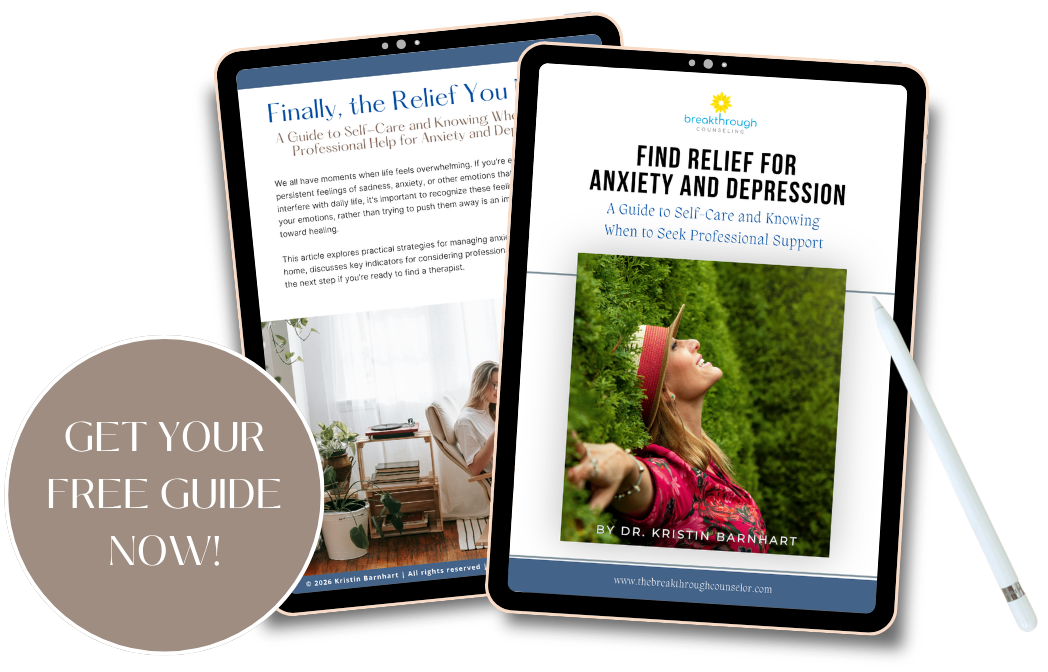
Find Relief for Anxiety and Depression: A Guide to Self-Care and Knowing When to Seek Professional Support is a place to start for ideas for taking care of yourself when things feel heavy and guidance for recognizing when it may be time to reach out for support.
Online Therapy for Anxiety and Relationship Concerns
I’m Dr. Kristin Barnhart, a licensed psychologist in Connecticut, couples therapist, and founder of Breakthrough Counseling, LLC. I’ve been a licensed clinician for more than 30 years and provide online anxiety counseling, individual therapy, and couples counseling.
I work with committed couples in many stages of life, including dating, engaged, newly married, long-married, parenting, empty nest, and later life.
Much of my work focuses on helping couples communicate more clearly, understand recurring conflict, repair trust, create healthier family boundaries, and feel emotionally close again.
I also provide online therapy for individuals navigating anxiety, depression, relationship conflict, stress, grief, and major life changes.
My approach is warm, practical, and shaped around what is happening in your real life. I use evidence-informed approaches, including Cognitive Behavioral Therapy (CBT), DBT skills, solution-focused therapy, and strengths-based care. Christian-integrated therapy is available when you request it.
I’m authorized through PSYPACT to provide telepsychology in more than 40 participating states.
To learn more about whether therapy may be a good fit, you’re invited to schedule a complimentary introductory call by calling or texting 860-333-8773.
This article is for educational purposes and is not a substitute for therapy, diagnosis, or emergency care



0 Comments